
We lay both, and both are good. This is not pavers against a cheap slab; it is two quality surfaces that give you a different look, a different price, and a different answer when something needs fixing. Here is how they compare on the clay and freeze-thaw we build in.
The short version
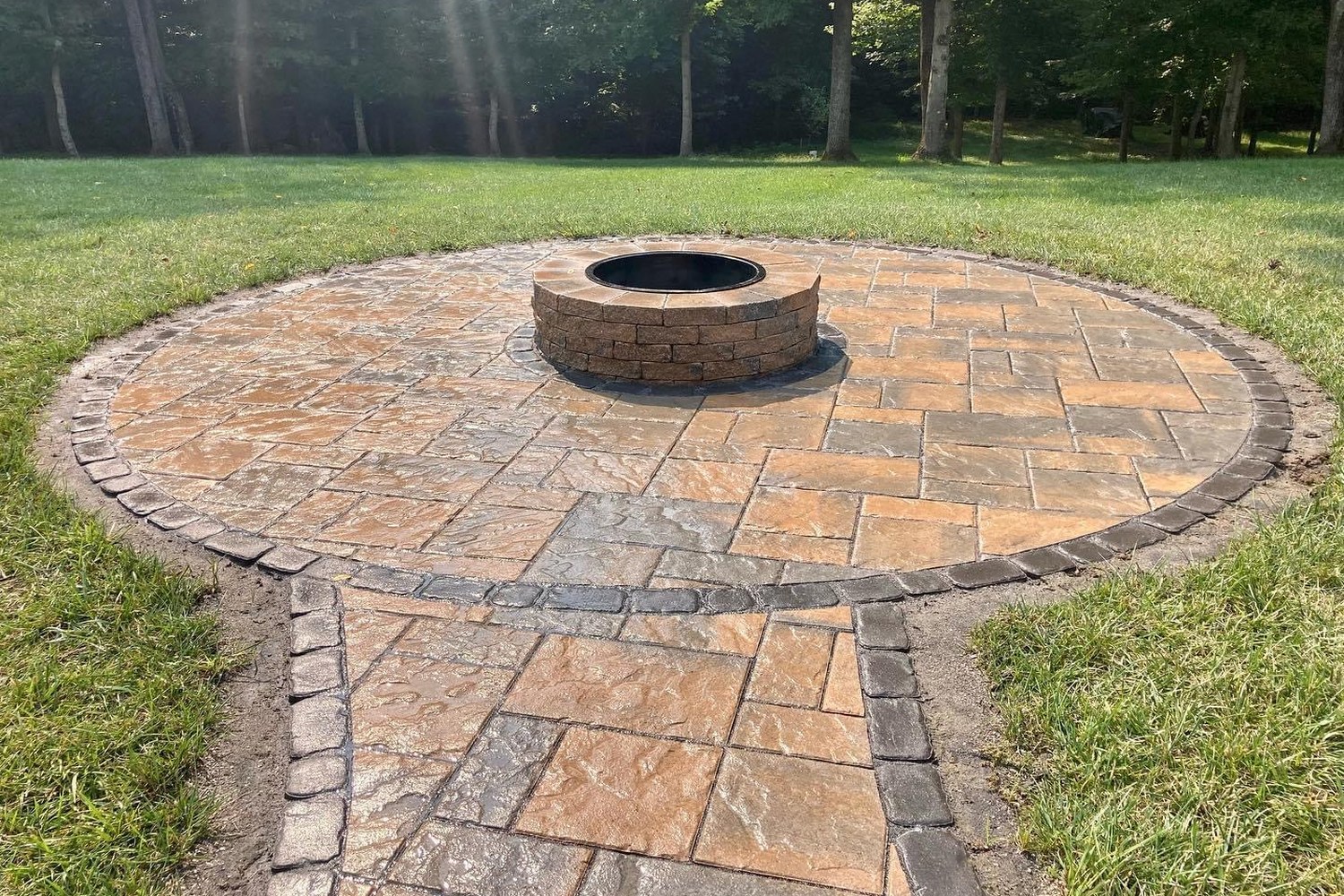
- Pavers are uniform, they interlock, and if one is ever damaged you lift it and drop in a new one. Lower cost, widest range of colors, built to flex with our frost.
- Flagstone is irregular natural stone. It costs more and takes longer to set, and on the right house nothing else looks like it.
- Both sit on the same compacted base. The base does not care what is on top of it.
| Concrete pavers | Natural flagstone | |
|---|---|---|
| Installed cost | about $10 to $20 per sq ft | about $15 to $35 per sq ft |
| Look | uniform, engineered, wide color range | irregular, natural, high-end |
| Freeze-thaw | built to flex with heave | great with dense stone, set in sand |
| Repairs | lift and swap one unit | source and cut a matching stone |
| Lifespan | 25 to 50 years | 50 years and up with dense stone |
What they cost
Concrete pavers run roughly ten to twenty dollars a square foot installed. Natural flagstone runs about fifteen to thirty-five, and bluestone, which is the flagstone we would point you toward here, sits at the upper end. Flagstone costs more for two reasons: the stone itself is dearer, and every irregular piece has to be hand-picked, cut and leveled to fit its neighbors, which is slow, skilled work. Pavers are uniform and modular, so they lay faster. One bit of good news for our area is that Pennsylvania is bluestone country, so it does not carry the freight cost here that it does in other parts of the country.
They go on the same base
Whichever you pick, the ground work is the same, and in our clay it is not optional. We excavate, lay and compact a base of at least four inches of stone over well-drained subgrade, and screed a bedding layer for the stone or paver to set into. In a freeze-thaw climate like ours, flagstone is best set in sand with sanded or polymeric joints, not locked in mortar, because a rigid mortar joint cracks when the ground moves. Pavers are engineered for exactly that movement, so the whole system flexes with the heave instead of fighting it.
Where the difference really shows: repairs
This is the practical line between them. If a paver ever cracks, stains, or settles, we lift that one paver and set a new one, and you cannot tell. Flagstone is harder. To fix a damaged piece we have to find a stone that matches and cut it to an irregular gap, and it rarely disappears the way a swapped paver does. If low fuss over twenty years matters to you, pavers win that point clearly.
The look is why people pay for flagstone
None of that changes the fact that flagstone looks like nothing else. The irregular shapes and the natural color, the browns and greys and blues, give a patio an organic, upscale feel that a manufactured product cannot quite copy, and the cleft surface has real grip underfoot when it is wet. Pavers answer back with consistency and range: one size and shape, a specific color to match the house, and tight joints that keep weeds down better than flagstone’s wider ones. It comes down to the look you want and the budget you have.
Which one for your patio
If the budget is the priority, the patio is large, or you want a specific color and a clean geometric pattern, pavers are the practical choice and they are most of what we lay. If the look is the priority and the budget allows it, flagstone, and specifically a dense bluestone set in sand, is worth the money and ages beautifully in our climate. Either way the base is the same and it is where the job is won, so build it right and either surface will outlast the reason you called us.
Common questions
Is flagstone or pavers cheaper?
Concrete pavers are cheaper, around ten to twenty dollars a square foot installed, versus fifteen to thirty-five for natural flagstone. Flagstone costs more because the stone itself is pricier and each irregular piece has to be hand-cut and fit, which is slower work than laying uniform pavers.
Which holds up better in freeze-thaw?
Both hold up well when they are built right. Pavers are engineered to flex with frost heave, so they handle our winters predictably. Dense flagstone like bluestone also lasts fifty years and up here, as long as it is set in sand with flexible joints rather than locked in mortar, which cracks when the ground moves. Porous flagstone is the one to avoid in this climate.
Do flagstone and pavers use the same base?
Yes. Both need the same excavated, compacted stone base, at least four inches over well-drained soil, with a screeded bedding layer on top. In our heavy clay that base is what keeps either surface from settling or heaving. The material on top does not change the ground work underneath.
Which is easier to repair?
Pavers, by a wide margin. A damaged paver lifts out and a matching one drops in without disturbing the rest. Repairing flagstone means sourcing a stone that matches and cutting it to an irregular gap, which is harder and rarely invisible. If easy repairs matter to you, pavers are the better pick.
Want to see both on your project? We lay pavers and natural flagstone and will help you choose. Call (724) 605-4822 for a free estimate.