
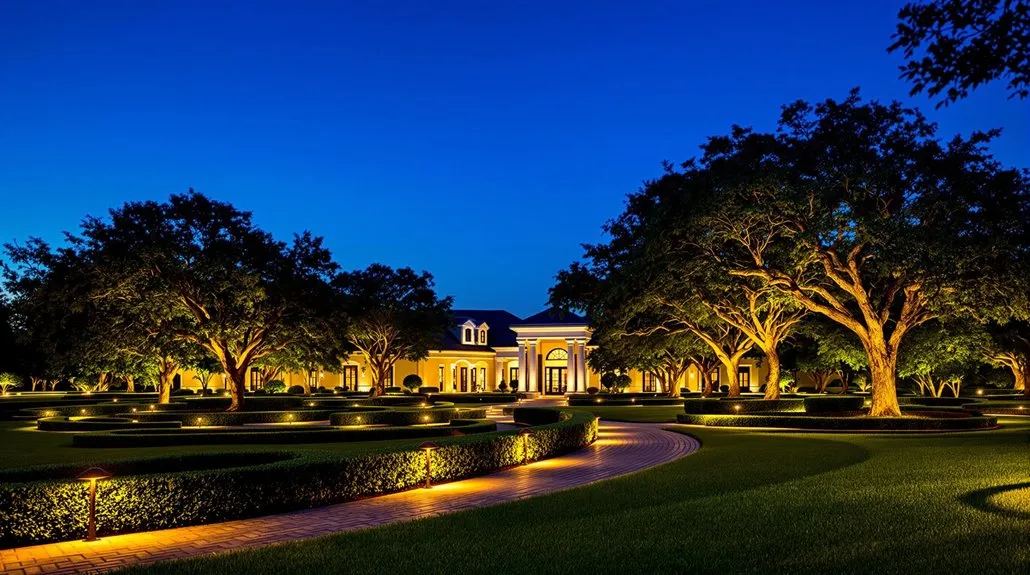
To plan commercial landscape lighting effectively, start by defining clear goals—security, curb appeal, or wayfinding. Map your site thoroughly, identifying dark zones and utility lines before selecting fixtures. Match fixture types to each zone, guarantee compliance with local codes and dark-sky ordinances, and layer ambient, accent, and task lighting strategically. Prioritize energy-efficient systems and plan for maintenance from day one. Keep going to uncover every detail that’ll make your project succeed.
Key Takeaways
Define clear lighting goals early—security, curb appeal, or wayfinding—to guide fixture selection, placement, intensity, and overall budget decisions.
Conduct day and night site walks to identify dark zones, utility lines, and high-traffic areas before planning begins.
Match fixture types to each zone: bollards for pathways, uplights for trees, sconces for entrances, and pole lights for parking.
Research local dark-sky ordinances, ADA illumination standards, and energy codes like ASHRAE 90.1 before finalizing fixture choices.
Group fixtures on separate circuits and document locations, model numbers, and installation dates to streamline long-term maintenance.
Define Your Commercial Landscape Lighting Goals Before Anything Else

Before diving into fixture selection or layout planning, set clear goals for your commercial landscape lighting project. Ask yourself what you’re trying to achieve. Are you prioritizing security, curb appeal, wayfinding, or all three?
Each goal drives different design decisions, from fixture placement to light intensity. A retail center needs bright, inviting entrances, while a corporate campus might emphasize subtle architectural accents.
Define your budget, energy targets, and maintenance expectations early. These parameters shape every choice that follows.
Clear goals prevent costly redesigns and keep your project aligned with both functional needs and aesthetic vision.
Map Your Site Before Choosing Any Fixtures
A thorough site map gives you the foundation every smart lighting decision depends on.
Walk your property during the day and again at night, noting existing light sources, dark zones, architectural features, pathways, trees, and signage.
Walk your property by day and night — what you miss in sunlight, darkness will reveal.
Mark utility lines, irrigation systems, and hardscape elements so you don’t have to guess during installation.
Measure distances between key points to calculate wire runs and voltage drop.
Identify high-traffic areas that need safety lighting versus decorative zones that benefit from accent fixtures.
Once you’ve documented everything, you’ll choose fixtures with purpose rather than assumption, saving time, money, and costly redesigns later.
Pick the Right Fixture Types for Each Landscape Zone
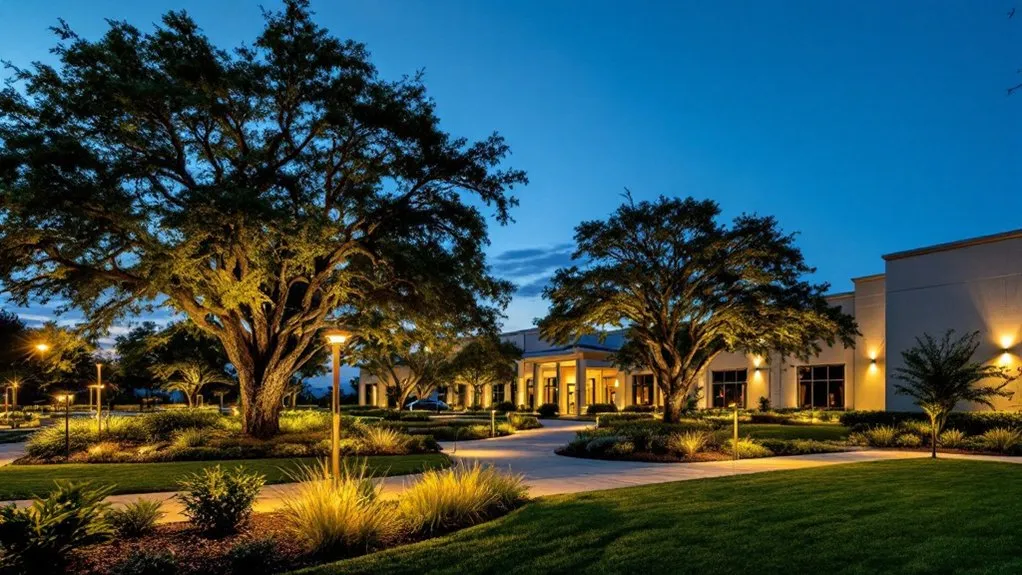
Each zone on your property has distinct lighting needs, and matching fixture types to those zones is what separates a polished installation from a patchwork one.
Use bollard lights along pedestrian pathways for low-level, directional illumination. Choose in-ground uplights to highlight trees, monuments, or architectural features.
Install wall-mounted sconces near building entrances to boost visibility and security. For parking areas, use pole-mounted fixtures with wide-distribution optics.
Ground-level step lights work well on stairs and retaining walls. When you match fixture function to zone purpose, you eliminate guesswork and avoid costly replacements later.
Know Your Compliance Requirements Before Finalizing Fixtures
Compliance requirements vary by municipality, so research local codes, dark-sky ordinances, and ADA standards before you commit to any fixture.
Local codes, dark-sky rules, and ADA standards vary by municipality — research all three before committing to any fixture.
Ignoring these early costs you time and money later.
Key requirements to verify:
Dark-sky ordinances restricting uplight and glare
ADA path illumination minimums for accessible routes
Energy codes like ASHRAE 90.1 or Title 24
Wetland or wildlife buffers limiting light trespass near protected areas
Utility easement restrictions affecting fixture placement
Confirm everything with your local authority having jurisdiction before finalizing your fixture selections.
Layer Ambient, Accent, and Task Lighting for a Polished Look
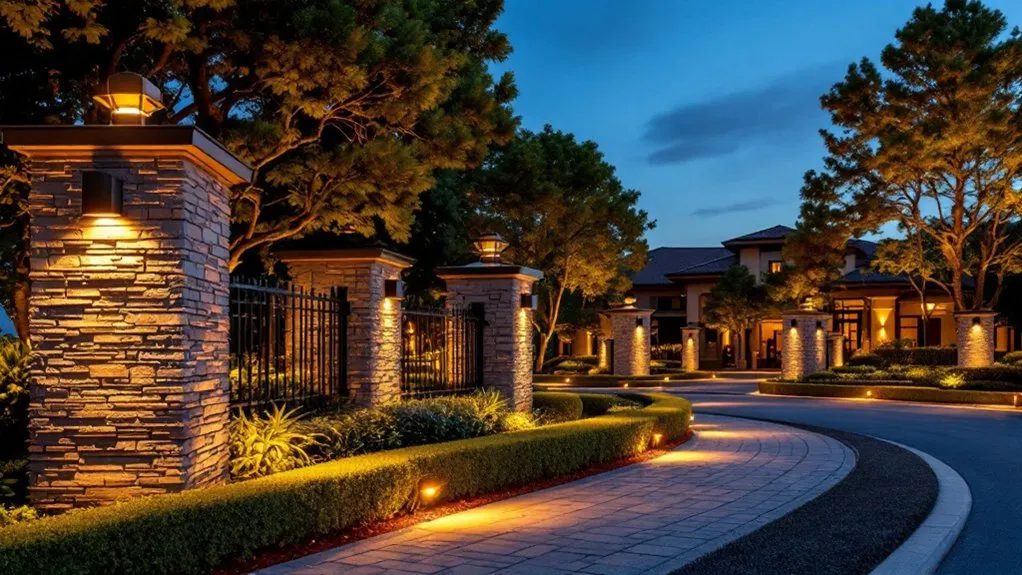
Once you’ve satisfied code requirements, layering ambient, accent, and task lighting transforms a flat, utilitarian installation into a cohesive, professional design.
Ambient lighting establishes your baseline illumination, covering broad areas like parking lots and walkways. Accent lighting highlights architectural features, signage, or landscaping, adding visual depth and brand presence. Task lighting serves specific functional zones—entryways, loading areas, or outdoor seating.
When you combine all three intentionally, you eliminate dark pockets, reduce glare, and guide visitors naturally through your space. Start with ambient light, add accent lighting, then refine with task lighting to achieve balance without over-illuminating any single area.
Choose Energy-Efficient Commercial Landscape Lighting Systems
Switching to energy-efficient systems cuts operating costs considerably while reducing your environmental footprint.
Today’s commercial landscape lighting technology delivers superior performance without wasting energy. Consider these smart options:
LED fixtures last up to 50,000 hours and consume 75% less energy than traditional bulbs
Solar-powered lights eliminate wiring costs and grid dependency
Motion sensors activate lights only when needed
Smart lighting controls let you schedule and dim fixtures remotely
Dark-sky-compliant fixtures direct light downward, minimizing waste
You’ll recover upfront investments quickly through lower utility bills and reduced maintenance expenses.
Plan for Maintenance Before the First Fixture Goes In
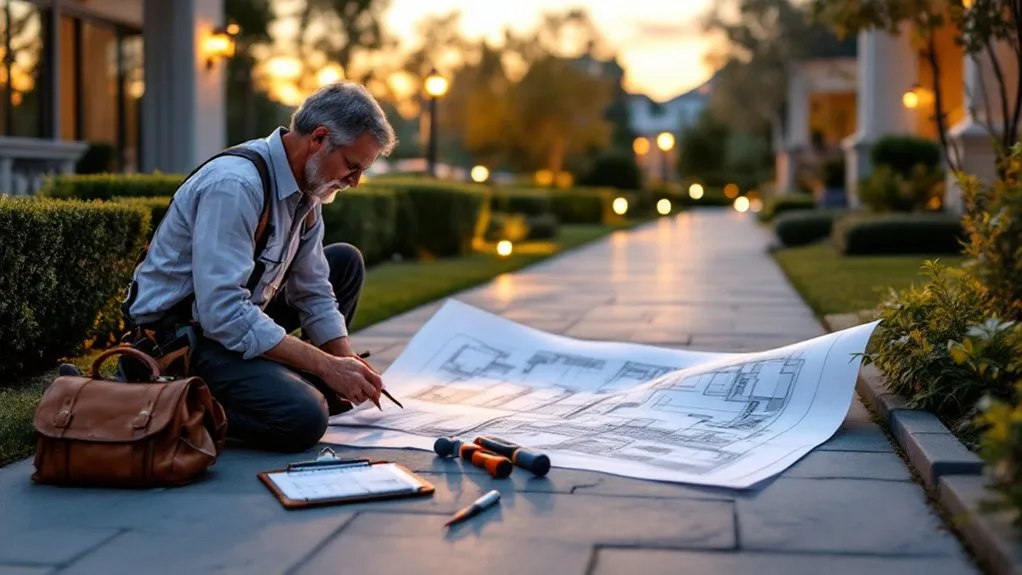
Many property owners install commercial landscape lighting without thinking about long-term upkeep, and that oversight gets costly fast.
Before installation begins, map out access points for every fixture. You’ll want enough clearance for technicians to replace bulbs, clean lenses, and inspect wiring without damaging surrounding landscaping. Choose fixtures with tool-free access panels when possible.
Plan fixture access routes before installation—technicians need clearance to service lights without tearing up your landscaping.
Group lights on separate circuits so a single failure doesn’t darken your entire property. Document every fixture’s location, model number, and installation date from day one.
That record saves time during repairs and helps you schedule preventive maintenance before small problems become expensive replacements.
Frequently Asked Questions
How Much Does Commercial Landscape Lighting Installation Typically Cost?
You’ll typically spend between $2,000 and $10,000+ for commercial landscape lighting installation, depending on your property’s size and complexity.
Smaller projects run around $2,000–$4,000, while larger commercial spaces can exceed $10,000. Your costs include fixtures, wiring, labor, and control systems.
High-quality LED fixtures cost more upfront but save you money long-term on energy bills.
Always get multiple contractor quotes to guarantee you’re getting competitive pricing.
Can Existing Landscape Lighting Systems Be Upgraded Without Full Replacement?
Yes, you can absolutely upgrade your existing landscape lighting system without starting from scratch.
You’ll often retrofit LED bulbs into your current fixtures, saving high costs. You can also add smart controls, timers, and dimmers to your existing wiring infrastructure.
However, have a licensed electrician assess your current system’s capacity and condition first. If your wiring’s outdated or damaged, partial replacements may still be necessary.
What Warranties Should I Expect From Commercial Landscape Lighting Manufacturers?
You should expect manufacturers to offer 3-10 year warranties on commercial landscape lighting products, depending on the component.
LED fixtures typically carry 5-7 year warranties, while drivers and electronic components often have 3-5 years.
Transformers usually come with longer coverage, sometimes lifetime warranties.
Always verify what’s covered—most warranties include defects in materials and workmanship but exclude installation errors or weather damage.
Request written documentation before purchasing.
How Do Weather Conditions Affect Commercial Landscape Lighting Performance and Lifespan?
Weather considerably impacts your commercial landscape lighting in several key ways:
Extreme heat accelerates LED degradation and shortens driver lifespan.
Moisture and humidity corrode connections if you haven’t chosen proper IP-rated fixtures.
Freeze-thaw cycles crack poorly sealed housings.
UV exposure fades lenses and reduces light output over time.
Wind and debris physically damage exposed fixtures.
You’ll dramatically extend lifespan by selecting fixtures rated for your local climate conditions.
Should I Hire a Lighting Designer or a General Landscaping Contractor?
For complex commercial projects, you should hire a dedicated lighting designer.
They’ll bring specialized knowledge in electrical systems, light physics, and aesthetic planning that a general landscaper simply can’t match.
However, if your project is straightforward and budget-sensitive, a skilled landscaping contractor with lighting experience can work well.
Ideally, you’d combine both—letting a lighting designer create the plan while your landscaping contractor handles installation and integration with existing outdoor elements.
Conclusion
Designing commercial landscape lighting doesn’t have to feel overwhelming when you’ve got a solid plan in place. You now have seven key tips to guide every decision, from setting goals to planning maintenance. Take your time mapping the site, layering your lighting, and choosing energy-efficient fixtures that meet compliance standards. When you approach the project strategically, you’ll create an outdoor space that’s both functional and visually impressive.