
This is a question we get every spring, and it usually comes down to one thing: people are tired of buying mulch every year and they want to know if stone is the fix. Sometimes it is. In an actual planting bed, most of the time it is not. Here is the honest breakdown.
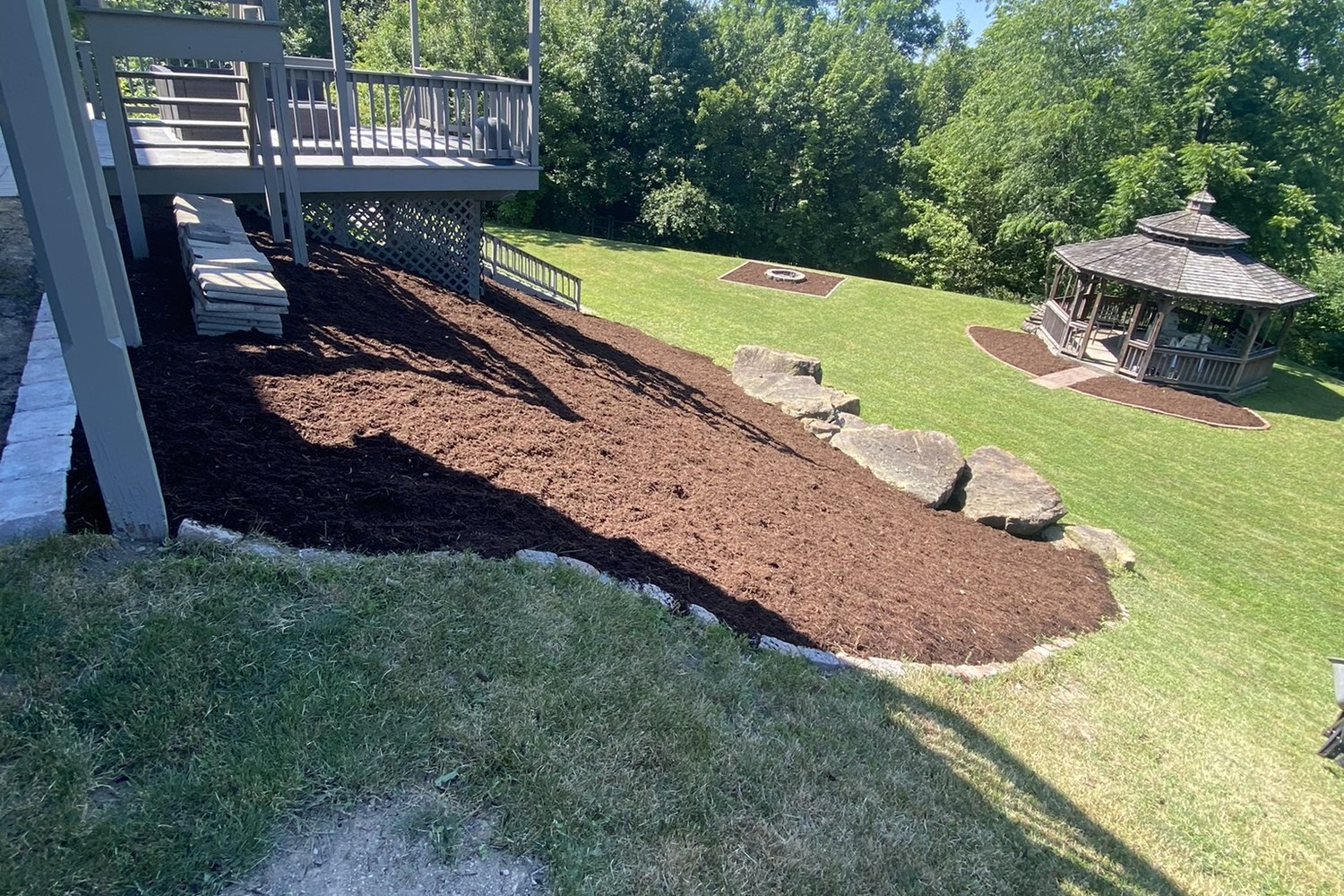
The short version
- Mulch costs less up front, feeds the soil, and is easy to change later. You refresh it every year or two.
- Stone costs more up front and lasts for years, which makes it right for drainage areas and slopes. In a planting bed it works against your plants and is a headache to remove.
| Mulch | Stone | |
|---|---|---|
| Installed cost | about $2 to $5 per sq ft | about $5 to $15 per sq ft, plus fabric |
| How often you redo it | top up every 1 to 2 years | lasts 10 years and up |
| Soil and plants | adds organic matter, holds moisture | adds nothing, radiates heat |
| Weeds | suppresses while it is fresh | weeds grow in debris on top |
| Best for | planting beds, trees, shrubs | drainage, dry creek beds, slopes |
What each one costs
Installed mulch runs roughly two to five dollars a square foot around here, which lines up with the seventy to ninety-odd dollars a cubic yard we quote for hardwood delivered and spread. Decorative stone and river rock land closer to five to fifteen dollars a square foot installed, and that is before the landscape fabric most people put under it. So stone starts at two to three times the price of mulch on day one.
Stone lasts longer, and that is the real argument for it
Mulch breaks down. In our climate a hardwood mulch is mostly gone in two to three years and looks tired after one, so you are topping it up every year or two. Stone does not decompose. Left alone it lasts ten, twenty years. On paper stone catches up to the cost of yearly mulch in about three years, and after that it looks cheaper. If nothing ever collected in it and it never sank, that math would hold.
What stone actually does in a planting bed
Here is where the paper math falls apart. Stone has no organic matter, so it does nothing for our heavy clay, which is the exact soil that needs organic matter to drain and stay workable. Stone also holds heat. On a sunny bed it warms up and radiates that heat onto the plants sitting in it, and they are the ones that struggle first in August. If the stone is crushed limestone it slowly raises the soil pH, which is a problem for the acid-loving plants that are everywhere around here: azaleas, rhododendrons, hollies, blueberries. And stone is heavy, so over a few years it sinks down into soft clay and you are renovating the bed anyway.
The landscape fabric under stone almost never works
Most stone beds go down over landscape fabric, and most of them disappoint for the same reason. Dust, leaves and dirt blow in and settle on top of the fabric, between the stones. Within a couple of seasons that layer is thick enough to grow weeds, and those weeds are rooting in the debris above the fabric, where the barrier does nothing. Worse, the roots grow down into the weave of the fabric, so when you pull them the fabric tears and the roots stay. The fabric itself breaks down in three to five years and the stone works its way into it. Fabric buys you a little time. It is not a fix.
Where we do use stone
None of this means we talk everyone out of stone. It is the right material in the right spot. We use it in drainage areas, dry creek beds, under downspouts, and on slopes where mulch would wash away with the first hard rain. In those places stone earns its cost and its permanence. We just do not put a whole flower bed under it and call it low maintenance, because that is not what you get.
The part that matters most
Match the material to the job. For active planting beds, around trees and shrubs, and anywhere you might replant later, mulch is the better material and it is kinder to our clay soil. For drainage, slopes and low-plant areas, stone is worth the money. If you are somewhere in between, we would rather walk your property and tell you which it is than sell you a yard of the wrong thing.
Common questions
Is stone really cheaper than mulch over time?
On materials alone, stone breaks even against yearly mulch in about three years. In a real planting bed, though, stone collects debris, grows weeds on top, sinks into clay, and is expensive to remove if you ever replant, so the long-run savings are smaller than they look. In a drainage area or a low-plant bed, where none of that happens, stone does come out cheaper over time.
Does stone stop weeds?
Not for long. Weeds do not usually come up through clean stone, but dust and organic debris collect on top of the stone and the fabric under it, and weeds root in that layer within a couple of seasons. They are harder to pull out of stone than out of mulch.
Can I put stone over my whole flower bed?
You can, but we usually advise against it. Stone adds no organic matter to our heavy clay, holds heat against your plants, and, if it is limestone, raises the soil pH away from what most local plants want. It is also semi-permanent, so changing the bed later means hauling all the stone back out. For beds with live plants, mulch is the better material.
Do I need landscape fabric under mulch?
No. Mulch works fine straight on the soil, and as it breaks down it feeds the soil, which is the point. Fabric under mulch just gets in the way of that. Fabric is mainly used under stone to slow it sinking, and even there it causes problems within a few years.
Not sure which your beds need? We will take a look and give you a straight answer. Call (724) 605-4822 for a free estimate.